| Cell Organelles | Membrane Type | Key Functions |
| Rough Endoplasmic Reticulum (RER) | Single membrane | 1. Protein synthesis : Produces secretory, membrane, and lysosomal proteins. 2. Ribosome attachment : Provides a surface for ribosomes to carry out translation. 3. Protein folding : Helps newly formed proteins attain proper 3D structure. 4. Disulfide bond formation: Stabilizes protein structure. 5. Glycosylation: Adds carbohydrate groups to proteins (glycoprotein formation). 7.Vesicle formation : Packs proteins into transport vesicles. 8. Protein transport: Sends proteins to the Golgi apparatus. 9. Membrane synthesis: Contributes to formation of cellular membranes. 10.Intracellular transport support : Helps in movement of materials within the cell. |
| Smooth Endoplasmic Reticulum (SER) | Single membrane | 1. Lipid synthesis: Produces phospholipids, cholesterol, and other lipids. 2. Steroid hormone synthesis: Helps in formation of steroid hormones (in endocrine cells). 3. Detoxification: Breaks down drugs, toxins, and harmful chemicals (especially in liver cells). 4. Carbohydrate metabolism : Involved in glycogen breakdown and glucose metabolism. 5. Calcium ion storage: Stores and releases Ca²⁺ ions (important for muscle contraction). 6. Membrane formation: Contributes to the production of cellular membranes. 7. Lipid transport: Helps in distribution of lipids within the cell. 8. Enzyme activity support : Contains enzymes for metabolic processes. 9. Muscle cell specialization : Forms sarcoplasmic reticulum for rapid calcium release in muscles. |
| Golgi Apparatus | Single membrane | 1. Protein modification: Modifies proteins received from the Rough Endoplasmic Reticulum. 2. Glycosylation : Adds carbohydrate groups to proteins and lipids. 3. Protein sorting: Sorts proteins based on their destination. 4. Packaging: Packs proteins and lipids into vesicles. 5. Secretion: Transports materials outside the cell (exocytosis). 6. Lysosome formation: Forms lysosomes containing digestive enzymes. 7. Lipid transport : Modifies and transports lipids within the cell. 8. Cell membrane renewal : Supplies materials for membrane formation. |
| Lysosomes | Single membrane | 1. Intracellular digestion : Breaks down macromolecules like proteins, lipids, carbohydrates, and nucleic acids. 2. Autophagy : Digests worn-out or damaged organelles. 3. Heterophagy : Destroys foreign particles like bacteria and viruses. 4. Waste removal : Eliminates cellular debris and waste materials. 5. Recycling of materials : Reuses breakdown products for new cell components. 6. Defense mechanism : Protects the cell by destroying harmful substances. 7. Enzyme storage : Contains hydrolytic enzymes active at acidic pH. 8. Role in apoptosis: Participates in programmed cell death. |
| Peroxisomes | Single membrane | 1. Oxidation reactions : Carries out oxidation of various biomolecules. 2. Hydrogen peroxide metabolism : Produces and breaks down H₂O₂ using catalase enzyme. 3. Detoxification : Neutralizes toxic substances and harmful chemicals. 4. Fatty acid β-oxidation :- Breaks down very long-chain fatty acids. 5. Lipid metabolism :- Involved in synthesis of certain lipids (e.g., plasmalogens). 6. Reactive oxygen species (ROS) control :- Protects cells from oxidative damage. 7. Photorespiration (in plants) :- Participates in photorespiratory pathway. 8. Cholesterol & bile acid metabolism :- Helps in liver-related metabolic processes. 9. Energy metabolism support :- Assists in cellular metabolic balance. |
| Mitochondria | Double membrane | 1. ATP production :- Generates energy through cellular respiration (powerhouse of the cell). 2. Oxidative phosphorylation :- Produces ATP via electron transport chain. 3. Krebs cycle (TCA cycle) :- Oxidizes nutrients to release energy. 4. Fatty acid oxidation :- Breaks down fatty acids to produce energy. 5. Regulation of apoptosis :- Controls programmed cell death. 6. Calcium ion storage :- Helps regulate intracellular Ca²⁺ levels. 7. Heat production :- Generates heat (thermogenesis), especially in brown fat. 8. Metabolic regulation :- Involved in various metabolic pathways. 9. Own genetic material :- Contains mitochondrial DNA (mtDNA) and ribosomes for partial self-replication. |
| Nucleus | Double membrane | 1. Control center of the cell :- Regulates all cellular activities. 2. Storage of genetic material :- Contains DNA (hereditary information). 3. DNA replication :- Duplicates genetic material before cell division. 4. Transcription :- Synthesizes RNA from DNA template. 5. Regulation of gene expression :- Controls which genes are active or inactive. 6. Nucleolus function :- Produces ribosomal RNA (rRNA) and assembles ribosomes. 7. Cell division control :- Coordinates processes like mitosis and meiosis. 8. Protein synthesis regulation :- Directs protein formation by sending mRNA to cytoplasm. 9. Nuclear membrane regulation :- Controls movement of substances in and out through nuclear pores. |
| Ribosomes | No membrane | 1. Protein synthesis : Main site of protein formation in the cell. 2. Translation : Decodes mRNA to assemble amino acids into polypeptide chains. 3. Peptide bond formation : Catalyzes bonding between amino acids. 4. Free ribosome function : Synthesizes proteins for use within the cell. 5. Bound ribosome function : Produces proteins for secretion or membranes (attached to RER). 6. Reading genetic code: Interprets codons on mRNA using tRNA. 7. Polysome formation : Multiple ribosomes translate a single mRNA simultaneously. 8. Enzymatic activity : Acts as a ribozyme (rRNA performs catalytic function). 9. Universal presence : Found in both prokaryotic and eukaryotic cells. |
| Centrosome | No membrane | 1. Microtubule organization : Acts as the main microtubule-organizing center (MTOC). 2. Spindle formation: Forms the mitotic spindle during cell division. 3. Chromosome separation : Helps in proper segregation of chromosomes. 4. Cell cycle regulation : Plays a role in progression of the cell cycle. 5. Centriole function : Contains a pair of centrioles that aid in spindle formation. 6. Cilia and flagella formation : Centrioles help form basal bodies for cilia/flagella. 7. Cell polarity maintenance : Helps maintain spatial organization of the cell. 8. Intracellular transport support: Assists in movement of vesicles via microtubules. |
| Cytoskeleton | No membrane | 1. Cell shape maintenance : Provides structural support and maintains cell shape. 2. Mechanical strength : Gives strength to withstand stress and deformation. 3. Intracellular transport :Facilitates movement of vesicles and organelles. 4. Cell movement : Enables cell motility (e.g., amoeboid movement, cilia, flagella). 5. Organelle positioning: Keeps organelles properly arranged within the cell. 6. Cell division support : Forms spindle fibers for chromosome movement. 8. Surface projections formation : Helps in formation of structures like microvilli. |
| Nucleolus | No membrane | 1. rRNA synthesis: Produces ribosomal RNA (rRNA). 2. Ribosome assembly : Combines rRNA with proteins to form ribosomal subunits. 3. Ribosome production: Acts as the main site of ribosome biogenesis. 4. Cell growth regulation: Plays a role in controlling cell growth and protein synthesis capacity. 5. Storage of ribosomal components: Temporarily stores rRNA and ribosomal proteins. 6. Stress response: Involved in cellular stress sensing and regulation. 7. Transport of ribosomal subunits: Sends assembled subunits to the cytoplasm for protein synthesis. |
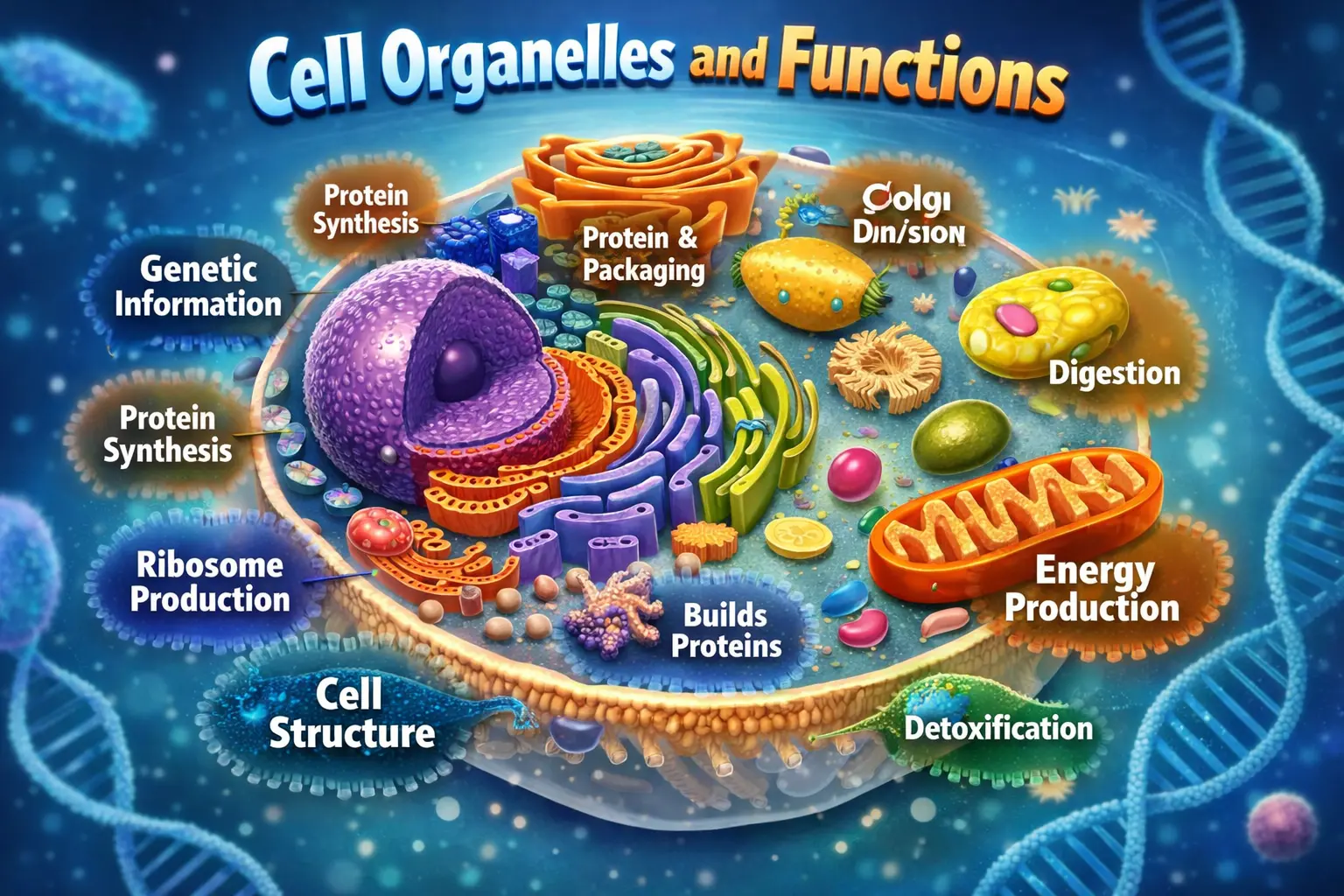
Cell organelles and functions